
Achilles Tendinopathy: Why It's Not Inflammation and What That Means


By Maria Josefina Cánepa Bustos
MSc Senior Musculoskeletal Physiotherapist · physiotherapist
AHPRA registered · PHY0002918524
Paediatric Musculoskeletal Sports Rehabilitation · Overuse Sport Injuries Rehabilitation · Dry needling · Therapeutic exercise
Maria Josefina Cánepa Bustos is a Senior Musculoskeletal Physiotherapist with a focus on sports and paediatric musculoskeletal rehabilitation, with eight years of clinical experience across private practice, sports clubs, and academic settings. Holds a Master of Science in Advanced Professional Practice in Paediatric Musculoskeletal Health, alongside postgraduate qualifications in therapeutic exercise and university teaching, with a focus on young athletes, injury prevention, and performance-based rehabilitation in sport settings.
Last reviewed: 14 November 2026
Achilles tendinopathy is primarily a load-related disorder involving changes in tendon structure, capacity and pain sensitivity, rather than a straightforward inflammatory injury. This means treatment usually focuses on education, modifying aggravating loads and progressively strengthening the calf and tendon, not simply resting or taking anti-inflammatory medication.
Key Takeaways
Persistent Achilles tendinopathy involves altered tendon structure and reduced load tolerance
Treatment centres on progressive strengthening and load management, not complete rest
Pain during exercise does not always mean further damage, and can be managed using a traffic light system
Recovery typically takes at least 12 weeks, with outcomes depending on early management and gradual loading
Understanding the difference between inflammation and structural change shapes realistic expectations and better treatment choices
Why Achilles tendinopathy is different from a simple inflamed tendon
The tissue changes in Achilles tendinopathy are not the same as the inflammation you might see after a sprained ankle. When you have persistent pain in the Achilles tendon, the tissue commonly shows altered collagen organisation, changes in tendon thickness and blood-vessel patterns, and reduced ability to tolerate load. A systematic review published in BMC Musculoskeletal Disorders described findings on inflammation in tendinopathy ranging from evidence of ongoing or chronic inflammation to predominantly non-inflammatory degenerative processes.
Pain also does not directly measure the amount of tendon damage. Symptoms can be influenced by recent activity, sleep, stress, sensitivity of the nervous system, muscle strength and expectations. Tendon imaging may show abnormalities in people without pain, so assessment should combine the history, physical examination and functional goals rather than rely on a scan alone.
This distinction matters because the tendon needs gradual, progressive loading to rebuild its capacity to tolerate the demands you place on it, whether that is running, walking up hills or playing weekend sport.
What is the difference between mid-portion and insertional Achilles tendinopathy?
The Achilles tendon can hurt in different places, and location matters. Mid-portion tendinopathy affects the tendon several centimetres above the heel bone. Insertional tendinopathy affects the tendon where it attaches to the heel. Deep ankle compression, including compression during a deep heel drop, may be more relevant to insertional symptoms, so exercise selection and range may need modification.
What causes Achilles tendinopathy and who gets it
Symptoms often develop when tendon loading exceeds current capacity. That might happen after increasing running volume, adding hills or speed work, jumping more often, or playing sport more frequently. A 2017 systematic review in Sports Medicine - Open found that Achilles tendinopathy is associated with a range of potentially relevant biomedical factors.
Reduced calf strength, changes in training, footwear, recovery, body weight, age and medical factors can also contribute. Achilles tendinopathy can occur without an obvious trigger.
In my practice, I often see people who have increased their training load, or who do not have a good strength training base, or who have changed their shoes. Sometimes it is casual football players who do not stretch, warm up or cool down after playing a match. Overuse injuries are preventable and treatable with exercise and load management, so education is a very important part of the care.
What this means for treatment
A physiotherapist can assess the location and irritability of symptoms, calf capacity, walking and running demands, footwear and contributing training factors. The Dutch multidisciplinary guideline on Achilles tendinopathy, published in the British Journal of Sports Medicine in 2021, recommends that basic management should include patient education, load management and progressive calf-muscle exercise, with gradual return to sport and activity.
Management commonly includes education, temporary load modification and progressive calf strengthening, often over at least 12 weeks. Complete rest is usually unnecessary and may reduce capacity. Progress is judged by pain, function and next-day response, not by eliminating every sensation immediately.
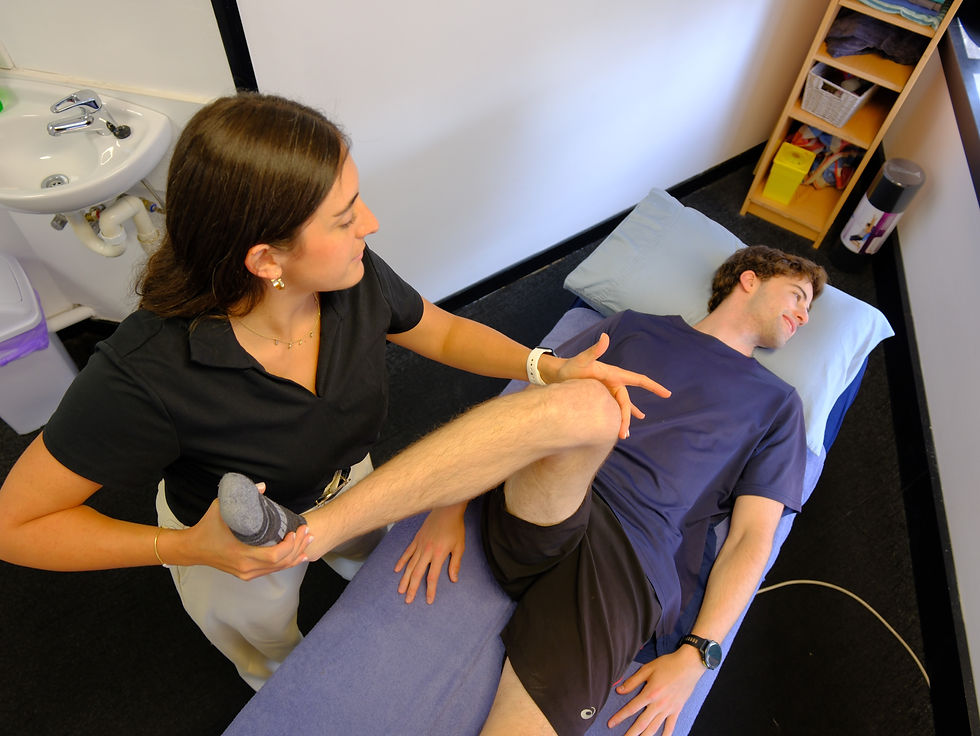
When I assess someone with Achilles tendinopathy, I start from the moment they walk into the room. I observe how they move, whether they are compensating, and how they are using the affected limb. I also pay attention to their body language, listening to what they say and what they do not say, the discomfort in certain positions, or the postures they adopt to avoid pain. From the movement assessment, I get a sense of their control and quality of movement, which helps me narrow down what may be driving those patterns. Once I have a clearer understanding, I combine hands-on treatment with active rehabilitation in a strategic way, rather than treating them as separate phases.
Can Achilles tendinopathy be managed in the early stages?
In early stages, Achilles tendinopathy can easily be managed so it does not turn into a chronic issue. If there is already a change in the structure of the tendon, not specific inflammation but more like a different organisation pattern of the fibres, there are specific exercises that will help optimise the structure and load-resistance of the rest of the healthy tendon.
What the research shows
The 2024 clinical practice guideline from the American Physical Therapy Association, published in the Journal of Orthopaedic & Sports Physical Therapy, recommends tendon-loading exercise, using loads as high as tolerated when appropriate, as a first-line intervention to improve function and reduce pain in mid-portion Achilles tendinopathy.
Progressive strengthening works because it gradually rebuilds the tendon's ability to tolerate load. The exercises are tailored to the location of symptoms, the stage of irritability, and the demands of the activity you want to return to. This might include calf raises done slowly with weights, two or three times a week, or exercises that target the muscles around the hip and core to reduce the load on the lower leg.
The Dutch multidisciplinary guideline emphasises that gradual return to sport and activity is part of the plan, not something that happens only after pain has completely disappeared. This approach reflects the understanding that tendinopathy is a load problem, and that the tendon needs to be progressively challenged to adapt.
How to manage pain during activity
One of the most common worries is whether you have to stop completely because of pain. The answer is usually no. With most overuse injuries, it is all about load management. Reducing intensity, frequency or duration is usually the key to continuing activity without aggravating symptoms.
I use a traffic light system for pain to help people understand how much pain is acceptable during activity. Pain between 0 and 3 out of 10 is the green zone, mild discomfort that does not prevent you from continuing. Pain between 3 and 5 out of 10 is the yellow zone, you can continue with caution, but you need to pay attention to how long it takes to settle and whether it worsens after activity. If it lingers or gets worse, then the load needs to be reduced. Pain above 5 or 6 out of 10 is the red zone, where your body is signalling that it is not tolerating the load at that time and you should stop.
This system helps you stay active while respecting the tendon's current capacity. It also takes the fear out of every sensation, because mild discomfort during a progressive loading program does not mean you are causing damage.
Should I use ice or anti-inflammatory medication for Achilles tendinopathy?
Avoid relying on anti-inflammatory medication or ice as the main treatment. Discuss medicines with a GP or pharmacist, particularly if symptoms are persistent, severe or associated with other medical conditions. Treatment should focus on progressive loading and load management rather than attempting to reduce inflammation.
When should I seek urgent assessment for Achilles pain?
Obtain prompt assessment after a sudden pop, major bruising, loss of push-off strength or inability to stand on tiptoe, as these features may indicate an Achilles rupture rather than tendinopathy. Seek help if walking becomes difficult or symptoms steadily worsen.
What you can do
Keep moving within tolerable limits rather than stopping all activity. Reduce or replace running, jumping, hills or speed work if symptoms are clearly aggravated, because complete rest can reduce tendon capacity.
Begin a progressive calf-strengthening program with a physiotherapist. Gradual loading helps rebuild capacity and function, and exercise choice and range should differ for mid-portion and insertional symptoms.
Monitor the response during activity and the following day. A temporary increase can occur, but persistent escalation suggests the load is too high and needs adjustment.
Common Questions
Should I stop running completely?
You usually do not need to stop completely. Reduce your running volume, intensity or frequency to a level that keeps pain in the green or yellow zone, and replace some sessions with cycling or swimming to maintain fitness. A physiotherapist can help you plan a graded return that builds capacity without overloading the tendon. Since overuse injuries are usually multifactorial, it often takes a few weeks or months to return to previous training loads. In the meantime, we focus on strengthening and preparing the tissues so that when you do progress, your body is able to tolerate that load safely.
How do I use the traffic light system for pain?
Pain between 0 and 3 out of 10 is the green zone, 3 to 5 is the yellow zone (continue with caution and watch how it settles), and above 5 or 6 is the red zone, where you should stop. I use this system with every patient because it takes the guesswork out of knowing how much is too much while keeping you active.
How long will recovery take?
Recovery typically takes at least 12 weeks, and sometimes longer depending on how long you have had symptoms, the severity of the changes in the tendon, and how consistently you follow the loading program. Early management makes a difference. Progress is gradual, and you judge it by how well you can do the activities that matter to you, not by the complete absence of every sensation.
Ready to rebuild your Achilles tendon’s capacity
If heel or Achilles pain is limiting your running, sport or daily activities, an assessment can work out where in the tendon the problem sits and what load it can currently handle. At Physio K in Bondi Junction, your first session starts with listening to your story, then we assess how you move and begin hands-on treatment in the same session. You’ll leave with a clear, graded loading plan. Book an appointment online to get started.
Reviewed by Mark Howlin. Mark Howlin is an Associate Physiotherapist at Physio K, specialising in sporting injuries and post-operative rehabilitation, with advanced dry needling training from Ireland and Sydney. Across six years of clinical practice in Ireland and Australia, he has developed particular expertise in chronic conditions such as anterior knee pain and Achilles tendinopathy, and acute lower limb muscle strains, using an integrated approach combining manual therapy, dry needling, and progressive rehabilitation. He has also served as team physiotherapist to elite GAA athletes, including during a championship-winning run at Croke Park. Registered with the Australian Health Practitioner Regulation Agency (PHY0004060355).
This article is for general information only and is not a substitute for personal medical advice. If you have concerns about your health, please consult a qualified clinician or your GP.


Comments